
Percent Phones Correct (PPC)
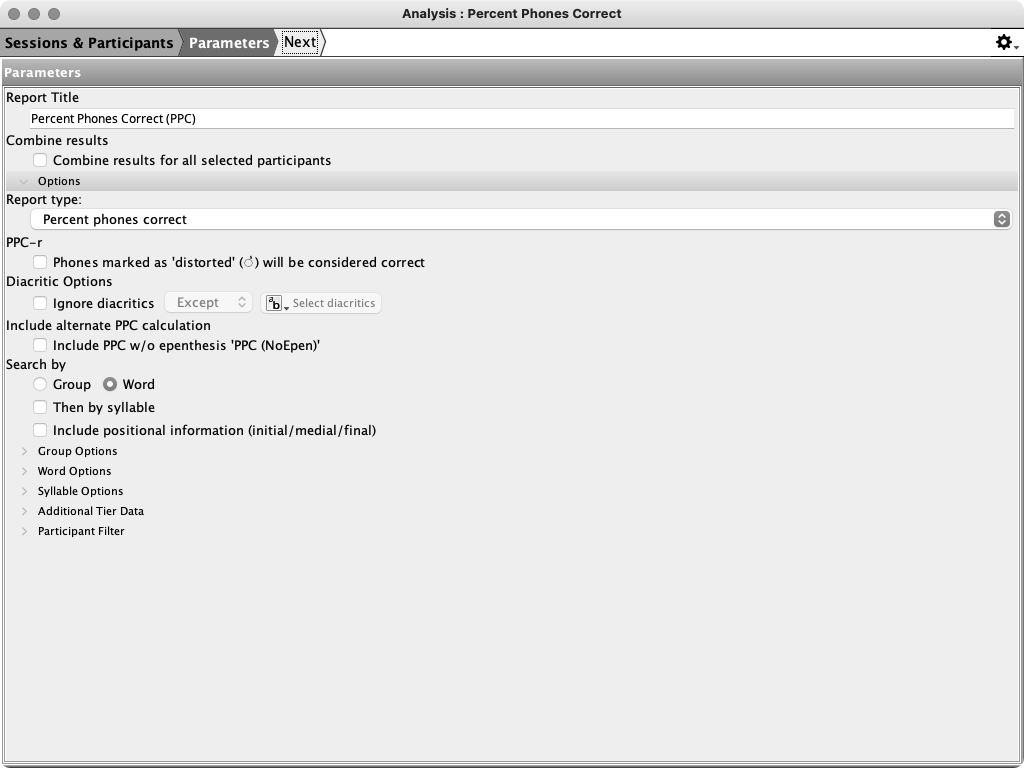
The Percent Phones Correct (PPC) analysis classifies selected phones in aligned IPA Target and IPA Actual words as correct, substituted, deleted, or epenthesized.
Despite its general title, the default report type is Percent consonants correct. Select another report type to measure all phones, vowels, a syllable-position class, or a custom phone set.
Before you begin
Check word boundaries and phone alignment between IPA Target and IPA Actual. For onset, nucleus, coda, singleton, and cluster report types, also check syllabification and syllable-constituent assignments.
Parameters
| Parameter | Default | Effect |
|---|---|---|
| Report Title | Percent Phones Correct (PPC) | Sets the title of the generated report. |
| Combine results for all selected participants | Off | Combines the selected participants before calculating summaries and pattern tables. |
| Transcriber | (validated) | Scores one blind transcriber's IPA Target and IPA Actual instead of the validated tiers; phone alignment is calculated when the analysis runs. Records without that transcriber's blind transcription on every blind IPA tier are skipped. Choices are the transcribers of the selected sessions. |
| Report type | Percent consonants correct | Selects the phone set used for all counts and percentages. |
| PPC-r | Off | When enabled, treats an aligned pair as correct if the target or actual phone is marked with the distorted diacritic. |
| Diacritic Options | Do not ignore diacritics | Optionally removes selected diacritics or all but selected diacritics before comparing aligned phones. |
| Include PPC w/o epenthesis “PPC (NoEpen)” | Off | Adds an alternate percentage that excludes epenthesized phones from its denominator. |
| Search by | Word | Calculates PPC for each aligned target/actual word pair. |
Available report types are all phones, consonants, consonants (no syllabic), vowels,
vowels (including syllabic), singleton consonants, cluster consonants, onset
consonants, coda consonants, nucleus phones, custom, and, under
Consonant dimensions,
PCC-Place, PCC-Manner, and
PCC-Voicing.
Percent consonants correct (no syllabic) excludes syllabic
consonants such as n̩ (Phonex {c,-syllabic}).
Percent vowels correct (including syllabic) counts vowels
and syllabic consonants together (Phonex [\v{c,syllabic}]). Cluster reports can include all, tautosyllabic, or heterosyllabic clusters. Onset
and coda reports can include all, singleton, or cluster constituents. Nucleus
reports can include all nuclei, monophthongs, or complex vocoids. The custom choice
exposes a required Phonex expression.
Standard result, word, syllable, tier, additional-tier-data, and participant filters can narrow or extend the aligned IPA Domains query. See Common Query Parameters and Phonex.
How PPC is calculated
Each target phone in the selected set is correct when its aligned actual phone has the same complete phone text after applying the comparison options. A different aligned phone is substituted and a target without an aligned actual phone is deleted. An actual phone in the selected set without an aligned target phone is epenthesized.
PCC-Place, PCC-Manner, and
PCC-Voicing count consonants (Phonex
\c) and compare one dimension only. A target consonant is
correct when its aligned actual consonant has the same broad class on that
dimension, whatever the other two: place is labial, coronal, or dorsal; manner is
obstruent, nasal, liquid, or glide; voicing is voiced or voiceless. A consonant
with no broad class on a dimension, such as h or ʔ for place,
matches only another such consonant. A consonant with two classes, such as
k͡p, needs both. A deletion, or a consonant produced as a vowel, is
always incorrect. Diacritic Options apply before the comparison. By default,
diacritics count: labialization (ʷ) adds labial place and voiceless
(◌̥) adds voiceless, so kʷ is incorrect for k on place.
Use Diacritic Options to ignore them.
PPC = # Correct / (# Correct + # Substituted + # Deleted + #
                    Epenthesized) × 100
.
When requested, PPC (NoEpen) = # Correct / (# Correct + # Substituted + #
Deleted) × 100.
For each target phone, # Target = # Correct + # Substituted + #
Deleted and % Correct = # Correct / # Target × 100.
Epenthesized phones have no target phone, so they are counted in a separate table
and do not affect the per-phone % Correct. When diacritics are ignored, phones that
differ only in ignored diacritics are counted as one phone.
Report output
| Section or table | Contents |
|---|---|
| Summary — All Participants | One row per speaker and a total row with # Target, # Actual, the four outcomes, PPC, and optional PPC (NoEpen). Each participant section repeats these measures by session. |
| IPA Patterns | Aligned target/actual phone pairs, frequency by session, and correct, substituted, deleted, and epenthesized totals. |
| Target Phones | One row per target phone with # Target, # Correct, # Substituted, # Deleted, and % Correct. Shown in each participant section and, for all participants, in the Summary section. |
| Epenthesized Phones | One row per epenthesized actual phone with # Epenthesized. Shown after Target Phones when there is at least one epenthesized phone. |
| PPC by Word | Every aligned word result with source-record information, IPA Target and IPA Actual, word index, outcome counts, PPC, and optional PPC (NoEpen). |
When a transcriber is chosen, the report title ends with (transcriber:
jdoe), every table has a Transcriber column, and the
PPC by Word (or Tier, or Syllable) listing names its IPA columns after the
transcriber, e.g. IPA Target (jdoe) and IPA Actual
(jdoe).
References
- Shriberg, L. D., & Kwiatkowski, J. (1982). Phonological disorders III: A procedure for assessing severity of involvement. Journal of Speech and Hearing Disorders, 47, 256–270.
- Shriberg, L. D., Austin, D., Lewis, B. A., McSweeny, J. L., & Wilson, D. L. (1997). The Percentage of Consonants Correct (PCC) Metric: Extensions and Reliability Data. Journal of Speech, Language, and Hearing Research, 40(4), 708–722.