
Index of Phonetic Complexity (IPC)
The Index of Phonetic Complexity (IPC) scores a word on eight phonetic parameters and sums them into a single complexity score. A higher score represents a phonetically more complex transcription.
Phon scores the aligned IPA Target and IPA Actual word separately, then reports the difference between their total scores. The implementation follows Jakielski (2022), The Index of Phonetic Complexity: At-a-Glance Scoring System, Terminology, Instructions, & Data Forms.
Before you begin
Check the syllabification of the IPA Target and IPA Actual words you want to analyze. The word-length parameter depends on the number of syllables containing a nucleus. Assign a speaker to each record so that the result has the correct participant label.
Run the analysis
- Select the corpora or sessions to include in the project window.
- Choose .
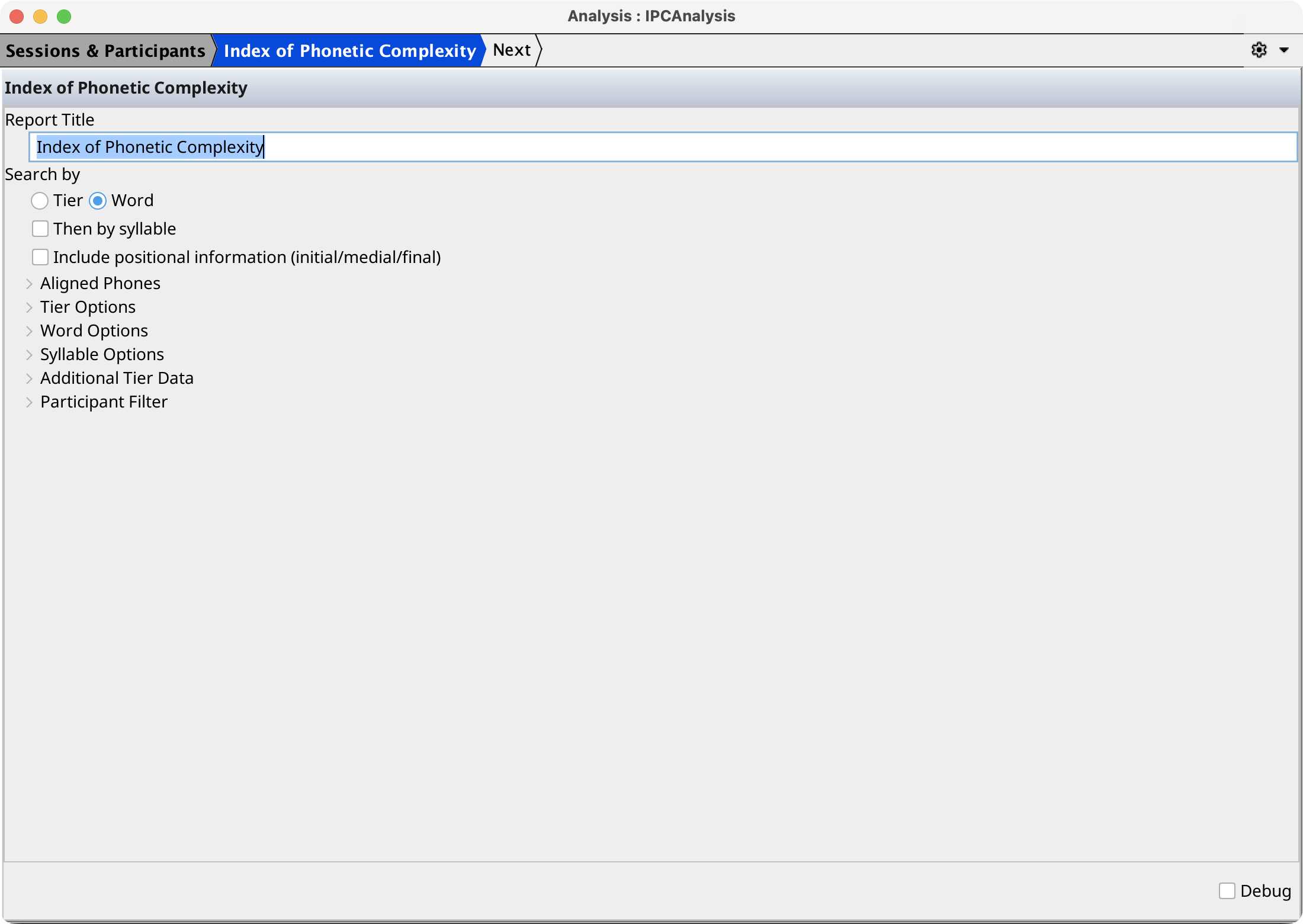
- Configure the Index of Phonetic Complexity parameters and run the analysis.
The stock Aligned IPA Domains query searches IPA Target, aligns IPA Actual, and groups results by word.
| Parameter | Default | Effect |
|---|---|---|
| Report Title | Index of Phonetic Complexity | Sets the title of the generated report. |
| Search by | Word | Searches the complete tier or groups results by word. The Then by syllable option can further divide either domain into syllable results; it is off by default. |
| Aligned Phones | Empty IPA Target and IPA Actual Phonex matchers | Optionally restricts the aligned productions that are scored. |
| Tier, word, and syllable options | No additional restriction | Filters the result by tier values, word properties, or syllable properties. |
| Additional Tier Data | No extra tiers | Adds selected aligned tiers or aligned words to the result table. |
| Participant Filter | No participant restriction | Restricts results by participant attributes. |
For details, see Common Query Parameters and Aligned Phones.
Scoring
Most parameters can contribute more than one point. Word shape and word length contribute at most one point each. The total IPC value is the sum of all eight parameter scores.
| Code | Parameter | Scoring |
|---|---|---|
D |
Place | One point for each dorsal segment. |
M |
Manner | One point for each fricative, affricate, or liquid. |
V |
Vowels | One point for each rhotic vowel. |
S |
Word shape | One point if the transcription ends with a consonant. |
L |
Word length | One point if the transcription has at least three syllables that contain a nucleus. |
P |
Place variegation | One point each time successive singleton consonants differ in their primary place features. Consonants that belong to a cluster do not participate in this comparison. |
C |
Contiguous clusters | One point for each sequence of contiguous consonants. |
T |
Cluster type | One point for each consonant cluster containing consonants with different primary place features. |
Report output
The report contains a Readme, an IPC table, and a Breakdown section.
IPC table
The IPC table has one row per aligned word. A trailing
t identifies an IPA Target score, and a trailing
a identifies the corresponding IPA Actual score.
| Column | Meaning |
|---|---|
| Session | Corpus and session containing the result. |
| Speaker | Participant assigned to the record. |
| Record # | Record number within the session. |
| IPA Target, IPA Actual | The two aligned word transcriptions. |
| Dt/Da, Mt/Ma, Vt/Va, St/Sa, Lt/La, Pt/Pa, Ct/Ca, Tt/Ta | Target and actual scores for each of the eight parameters. |
| IPCt, IPCa | Total target and actual complexity scores. |
| Δ | IPCt − IPCa. A positive value means that the target has the higher score; a negative value means that the actual has the higher score. |
If you add Orthography under Additional Tier Data, an Orthography column is included before the IPA columns.
Breakdown
The Breakdown section supplies an explanation for each distinct IPA transcription in the results. It identifies the segments, syllables, and clusters that contributed to each parameter and shows the resulting total. Repeated occurrences of the same transcription share one explanation.