
Phone Inventory
The Phone Inventory analysis counts the phones found independently on the IPA Target and IPA Actual tiers. It reports the number of unique target and actual consonants and vowels and compares their token frequencies by participant and session.
Use this analysis to examine which phones occur in the selected data and how often they appear, without treating target-to-actual differences as accuracy scores.
Before you begin
Assign a speaker to each record so that its phones are included in the appropriate participant inventory. The default query searches IPA Target and IPA Actual by word, so check word boundaries on both tiers.
The two tiers are searched separately. Phone alignment is not used to calculate the inventory counts. It is used only to add the corresponding phone and alignment to a token result when Include aligned phones is selected.
Parameters
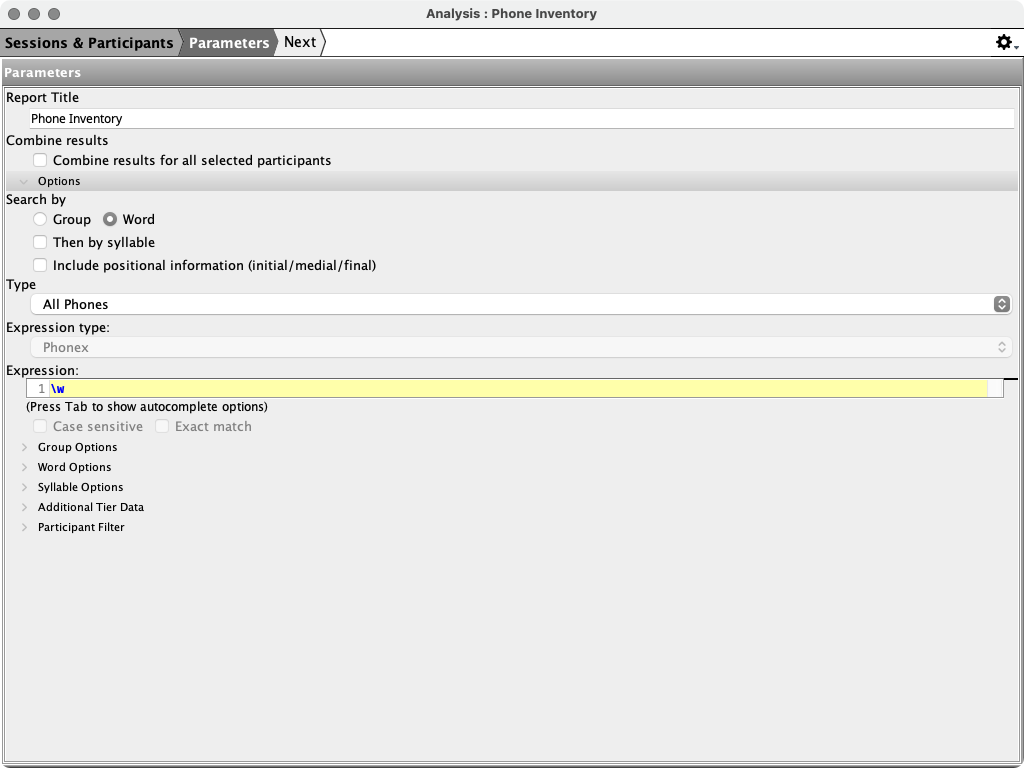
The analysis opens at the Parameters step. Its principal controls are:
| Parameter | Default | Effect |
|---|---|---|
| Report Title | Phone Inventory | Sets the title of the generated report. |
| Combine results for all selected participants | Off | Combines selected participants instead of producing separate participant inventories. Results remain identifiable by session. |
| Include aligned phones | On | Adds the phone aligned on the other IPA tier and its alignment to each result. It does not change which phone is counted in that tier's inventory. |
| Aligned Phones | Empty IPA Target and IPA Actual Phonex matchers | Optionally filters a matched phone using the corresponding aligned production. |
| Search by | Word | Searches every phone in the selected target and actual words. Word, syllable, tier, and participant controls can narrow the data. |
The remaining expandable controls are the standard tier, word, syllable, additional-tier-data, and participant filters. See Common Query Parameters and Aligned Phones.
How phones are counted
Each returned phone contributes one token to the inventory for its source tier. The IPA Target and IPA Actual totals are calculated independently; a substitution, for example, contributes the target phone to the target inventory and the produced phone to the actual inventory.
Inventory and unique-phone calculations ignore diacritics and letter case. Forms that differ only by diacritics therefore share one inventory row. The token listings retain the query results and their source-record information.
Summary counts divide the inventory into consonants and vowels. Inventory tables use Phon's IPA ordering, which groups consonants and vowels according to their phonetic properties rather than sorting their symbols as plain text.
Report output
The report begins with Readme and Parameters, followed by these sections:
| Section or table | Contents |
|---|---|
| Summary | One table per participant and one row per session. Each row lists participant role and age plus the number of unique target consonants, target vowels, actual consonants, and actual vowels. |
| Aggregate | For each participant, IPA Target Inventory and IPA Actual Inventory list every phone with a separate frequency column for each session. |
| Breakdown | For each participant, Target Consonants and Target Vowels pool target frequencies across the selected sessions. Each session also has a table that places IPA Target and IPA Actual totals beside each other for every phone. |
| Listing (IPA Target) | Lists every matched target phone with its source session, participant, and record. With aligned phones enabled, it also shows the corresponding IPA Actual phone and alignment. |
| Listing (IPA Actual) | Lists every matched actual phone with its source session, participant, and record. With aligned phones enabled, it also shows the corresponding IPA Target phone and alignment. |
Select a token in either listing to open its source record.