
Percent Phones Correct (PPC)
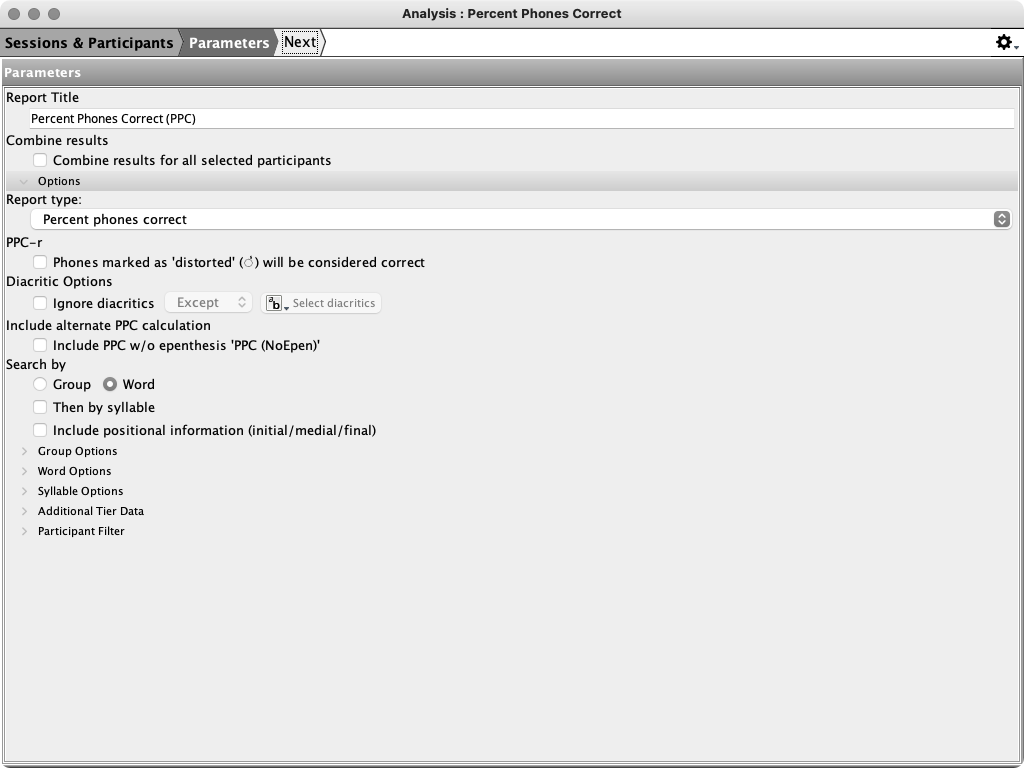
The Percent Phones Correct (PPC) analysis classifies selected phones in aligned IPA Target and IPA Actual words as correct, substituted, deleted, or epenthesized.
Despite its general title, the default report type is Percent consonants correct. Select another report type to measure all phones, vowels, a syllable-position class, or a custom phone set.
Before you begin
Check word boundaries and phone alignment between IPA Target and IPA Actual. For onset, nucleus, coda, singleton, and cluster report types, also check syllabification and syllable-constituent assignments.
Parameters
| Parameter | Default | Effect |
|---|---|---|
| Report Title | Percent Phones Correct (PPC) | Sets the title of the generated report. |
| Combine results for all selected participants | Off | Combines the selected participants before calculating summaries and pattern tables. |
| Report type | Percent consonants correct | Selects the phone set used for all counts and percentages. |
| PPC-r | Off | When enabled, treats an aligned pair as correct if the target or actual phone is marked with the distorted diacritic. |
| Diacritic Options | Do not ignore diacritics | Optionally removes selected diacritics or all but selected diacritics before comparing aligned phones. |
| Include PPC w/o epenthesis “PPC (NoEpen)” | Off | Adds an alternate percentage that excludes epenthesized phones from its denominator. |
| Search by | Word | Calculates PPC for each aligned target/actual word pair. |
Available report types are all phones, consonants, vowels, singleton consonants, cluster consonants, onset consonants, coda consonants, nucleus phones, and custom. Cluster reports can include all, tautosyllabic, or heterosyllabic clusters. Onset and coda reports can include all, singleton, or cluster constituents. Nucleus reports can include all nuclei, monophthongs, or complex vocoids. The custom choice exposes a required Phonex expression.
Standard result, word, syllable, tier, additional-tier-data, and participant filters can narrow or extend the aligned IPA Domains query. See Common Query Parameters and Phonex.
How PPC is calculated
Each target phone in the selected set is correct when its aligned actual phone has the same complete phone text after applying the comparison options. A different aligned phone is substituted and a target without an aligned actual phone is deleted. An actual phone in the selected set without an aligned target phone is epenthesized.
PPC = # Correct / (# Correct + # Substituted + # Deleted + #
                    Epenthesized) × 100
.
When requested, PPC (NoEpen) = # Correct / (# Correct + # Substituted + #
Deleted) × 100.
Report output
| Section or table | Contents |
|---|---|
| Summary — All Participants | One row per speaker and a total row with # Target, # Actual, the four outcomes, PPC, and optional PPC (NoEpen). Each participant section repeats these measures by session. |
| IPA Patterns | Aligned target/actual phone pairs, frequency by session, and correct, substituted, deleted, and epenthesized totals. |
| PPC by Word | Every aligned word result with source-record information, IPA Target and IPA Actual, word index, outcome counts, PPC, and optional PPC (NoEpen). |
References
- Shriberg, L. D., & Kwiatkowski, J. (1982). Phonological disorders III: A procedure for assessing severity of involvement. Journal of Speech and Hearing Disorders, 47, 256–270.
- Shriberg, L. D., Austin, D., Lewis, B. A., McSweeny, J. L., & Wilson, D. L. (1997). The Percentage of Consonants Correct (PCC) Metric: Extensions and Reliability Data. Journal of Speech, Language, and Hearing Research, 40(4), 708–722.