
Word Match
The Word Match analysis compares aligned IPA Target and IPA Actual forms. For every result, it reports whole-tier equality and edit distance, CV pattern equality, stress-pattern equality, and syllable-count equality.
Before you begin
Enter corresponding IPA Target and IPA Actual forms, check their syllabification and word alignment, and assign a speaker to each record. The analysis compares the aligned domains returned by its query; incorrect word or syllable alignment changes the comparison sample.
Parameters
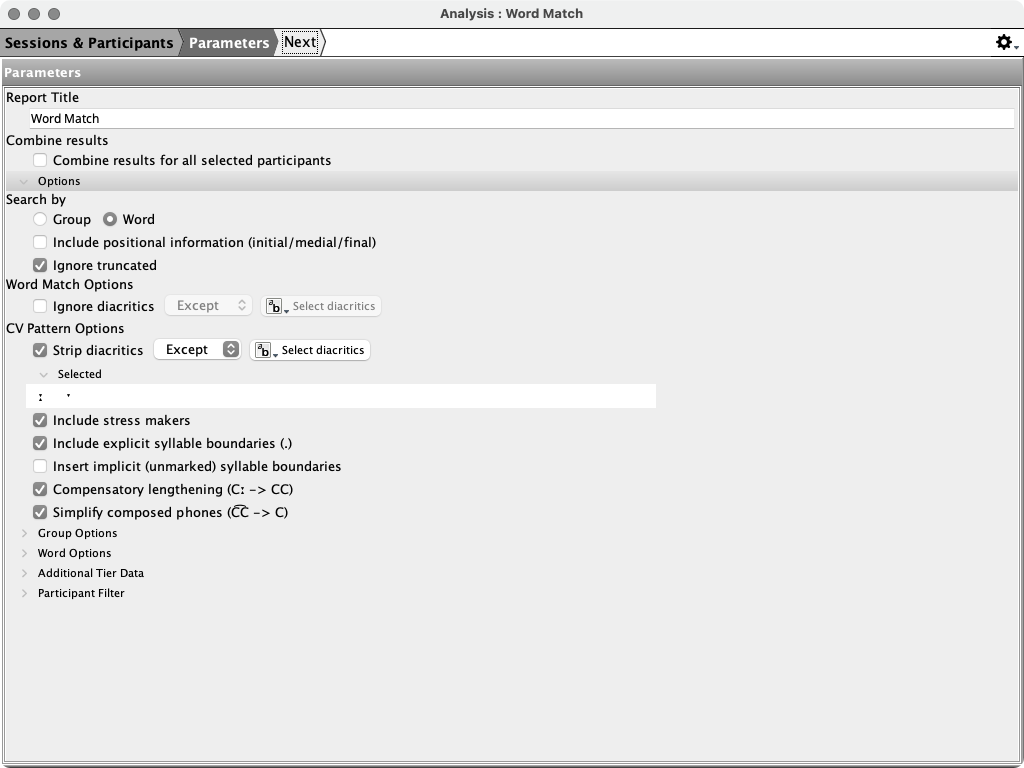
The analysis assistant opens with the following defaults. Change the query filters when you need to restrict the sample by tier, aligned phone result, word, syllable, or participant. See Common Query Parameters for the shared filter controls.
| Option | Default | Effect |
|---|---|---|
| Report Title | Word Match |
Sets the report's top-level title. |
| Combine results for all selected participants | Off | Treats the selected participants as a combined participant when enabled. |
| Search by | Word | Selects group, word, or syllable as the query domain. |
| Ignore truncated | On | Omits a comparison when the corresponding IPA Actual form is empty. |
| Word Match Options: Ignore diacritics | Off | Removes the selected diacritics before calculating whole-tier equality and edit distance. Use Only to remove only the selected diacritics, or Except to retain the selected diacritics and remove the others. |
The Aligned Phones section provides separate IPA Target and IPA Actual Phonex matchers. The remaining collapsible sections provide tier, aligned-tier, word, aligned-word, syllable, additional-tier-data, and participant filters.
CV Pattern options
These options control how the target and actual CV patterns are normalized before they are compared.
| Option | Default | Effect |
|---|---|---|
| Strip diacritics | Off | Removes only or all except the selected diacritics from the CV pattern. |
| Include stress markers | On | Keeps stress markers in the pattern. |
| Include explicit syllable boundaries (.) | On | Keeps explicitly entered syllable boundaries. |
| Insert implicit (unmarked) syllable boundaries | Off | Adds a boundary between syllables when no stress marker or explicit boundary marks the break. |
| Compensatory lengthening (Cː → CC) | On | Represents a long or half-long consonant, glide, or vowel as two units. This has no effect when its length diacritic is stripped. |
| Simplify composed phones (C͡C → C) | On | Represents a phone joined by a tie bar as one CV unit. |
How matches are calculated
- Distance and Tier Match
- Distance is the number of character insertions, deletions, and substitutions needed to change the normalized IPA Target string into IPA Actual. Tier Match is true only when the two normalized strings are equal.
- CV Match
- Compares the target and actual patterns produced with the CV Pattern options.
- Stress Match
- Compares the complete target and actual stress patterns.
- Syllable Count Match
- Compares the number of syllables in IPA Target and IPA Actual.
Reading the report
The report begins with a global Summary and Readme. The global summary has one row per participant and reports word count, average distance, and match and mismatch counts and percentages for all four comparisons.
Each participant section contains:
- a session-level Summary with the same measures and the participant's age when available;
- Matches and Mismatches listings based on Tier Match;
- CV Patterns, Stress Patterns, and Syllable Count Patterns inventories, each with target, actual, match, total, and percentage columns; and
- separate match and mismatch listings for CV pattern, stress, and syllable count.
A final Listing contains every analysed result and all calculated comparison fields. A match or mismatch table can be empty when the sample contains no result of that type.
References
Bernhardt, B. M., Stemberger, J. P., Bérubé, D., Ciocca, V., Freitas, M.-J., Ignatova, D., Kogošek, D., Lundeborg Hammarström, I., Másdóttir, T., Ozbič, M., Perez, D., and Ramalho, A. M. (2020). Identification of protracted phonological development across languages: The Whole Word Match and basic mismatch measures. In E. Babatsouli, M. Ball, and N. Müller (Eds.), An Anthology of Bilingual Child Phonology (pp. 274–308). Multilingual Matters.
Bernhardt, B., and Gilbert, J. (1992). Applying linguistic theory to speech-language pathology: The case for nonlinear phonology. Clinical Linguistics and Phonetics, 6, 123–145.